I’m sure you’re familiar with situations where you’re sitting in a meeting, disagree with your supervisor or colleague, and keep your opinion to yourself. Maybe you only confide in your loved ones or complain at home. Or you express your disagreement in an annual, strictly anonymised satisfaction survey.
You probably find yourself in an environment where psychological safety is not at its highest level.
Psychological safety, according to expert on the subject Amy C. Edmondson, can be defined as:
“The belief that one can voice thoughts, doubts, questions, and disclose one’s mistakes without being punished or humiliated for doing so.”
Psychological safety is a key factor in the effective functioning of any organization. It is an environment where people are not afraid to express their opinions, be themselves or even make mistakes.
There are many organisations that have what is known as a culture of silence. This means that:
The difference between psychological safety and danger is apparent. Negative environments have a destructive impact on the psychological health of employees and overall company performance.
The result is higher turnover rates, higher levels of stress and the risk of burnout syndrome.
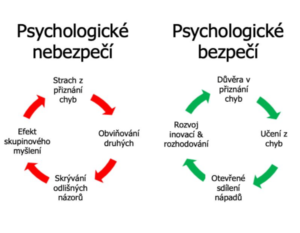
The topic of psychological safety affects the entire functioning of an organization. The nature of this topic requires that it be addressed at the organizational level, i.e. from the top down, from the top management of the organization to the rank-and-file employees.
The following steps can help to increase the level of safety:
Support open communication and feedback across the organization.
Cultivate work with conflict, do not sweep problems under the carpet. Use the principles of non-violent communication: this is how I feel – this is what I need – what do you need.
Teach employees at all levels how to work with mistakes. Develop an approach to mistakes as a tool for development.
Management should set an example in a constructive approach to difficult issues.
Support diversity of opinions and attitudes.
Even in organizations that show a high level of psychological safety, some topics are still too sensitive to be discussed openly between employees and colleagues, or with superiors.
This is where EAP – Employee Assistance Program can help. This program provides anonymous support to employees in solving work and personal problems in the areas of psychology, finance or law. It opens up topics that are not possible, for whatever reason, in the normal working regime. This employee assistance program can play a key role in building a healthy and safe environment.
EAP programs can be a valuable source of information for an organization, providing anonymized reports on topics that employees are dealing with. The organization can thus focus on them preventively.